INTRODUCTION
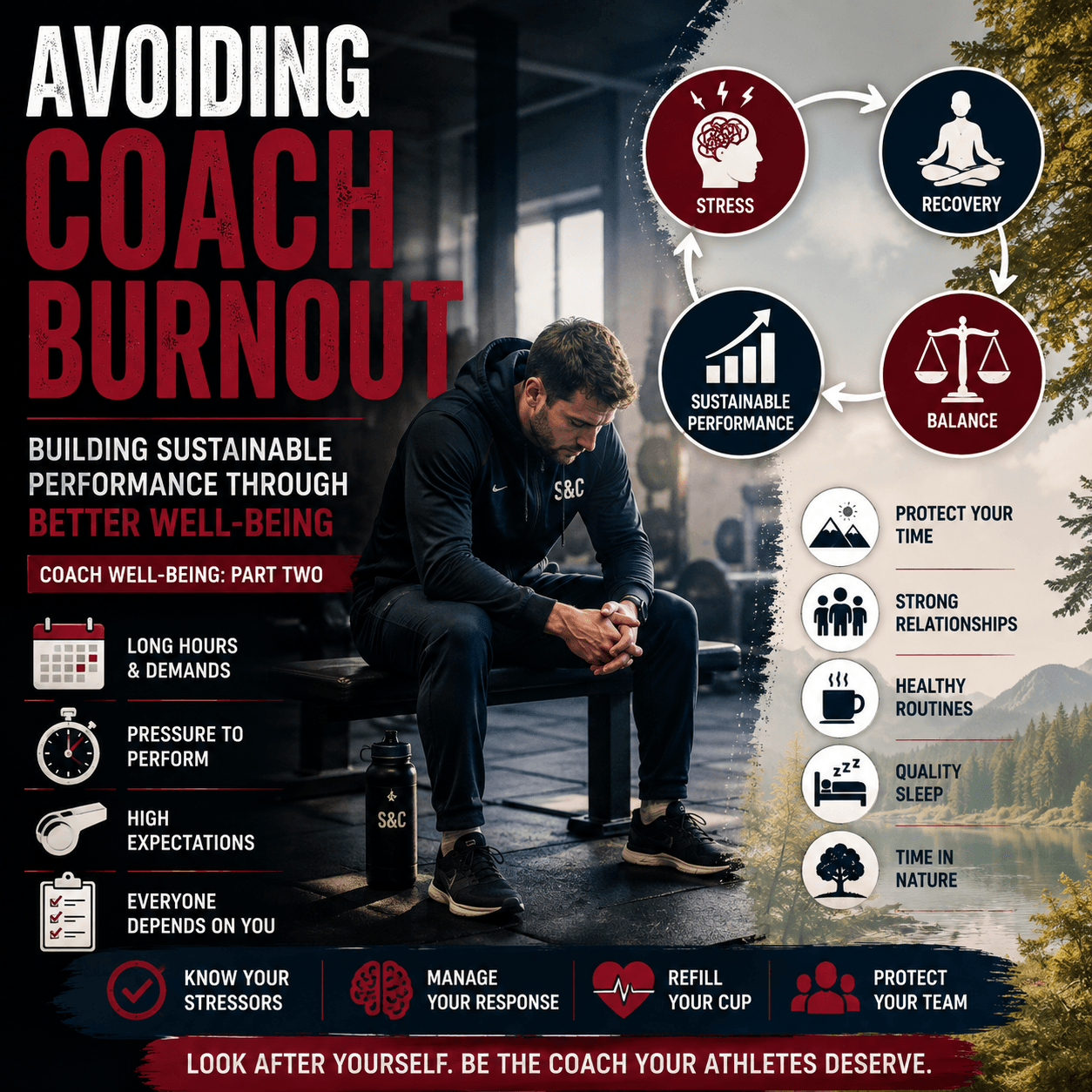
This article, with contributions from both Josh Fletcher (JF) and Richard Husseiny (RH), takes four really pertinent and sometimes painful topic areas and discusses them from two very different angles to give S&C coaches a diverse and informed stance.
Fundamental to each article in this coach wellness series is the practical advice. Some of this relates to tangible actions you can take now, whereas other concepts encourage you to think deeper and peel back the layers relating to you the practitioner and you the person.

1. Work-life balance is a myth
RH: I believe you can aim for a work-life balance.
JF: The work-life balance is a purple unicorn situation for me: in my view it does not exist – it’s something we can chase after like a rainbow, but we’ll never find it, or maybe we’ll find it for a short time and then it will disappear.
I prefer the term work-life harmony: as work is a part of our lives, we have to find a way to integrate it into our lives, not let it take over our lives.
There are always going to be ups and downs personally and professionally which are going to require more time and attention than we might like; for example if we are involved in the playoffs or a World Cup, this will probably require us to put extra time and energy into our work. But this needs to come with the understanding and conscious awareness that time/energy needs to be reclaimed later in order to regenerate effectively.
Work-life harmony to me is about integrating work into life, not the other way around.
RH: Certainly, from my research, the demands of high-performance sport are making many coaches unable to experience any form of balance in their life and searching for this elusive balance in some cases is causing many practitioners more struggle than relief.
Just the very fact that many sports are played at weekends makes this balance difficult, before even thinking about the travel to local and international competitions, the training camps and the major tournaments.
It seems to me that a major element as to why balance is unobtainable is down to many practitioners accepting and buying into the cultural pressure promoting the idea that it requires sacrifice to be a successful and world-class practitioner in elite sport.
However, we need to investigate what sacrifice truly means:
a) Sacrifice over the short term. For example, a 6-12 week period leading into and including training camps and major competitions. This requires being away from home and family, with long days (>14 hours) that lead to less available time to devote to self-care.
b) Sacrifice over the long term that is underpinned by a mindset that it needs to be a 24/7 mentality, a ‘first in, last out’ attitude, which is a skewed sense of loyalty to the idea of team organisation.
Here is a quote from a senior technical coach (Elite Rugby League) who bought into this idea of sacrifice:
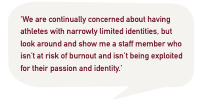
‘This is what I’m talking about regarding cultural pressure, and for what? A trophy? A badge on your chest? To say you’re the best? Until we change this concept of what it actually means to make sacrifices, we will continue to lose more and more brilliant performance staff who are now choosing their life over sport.’
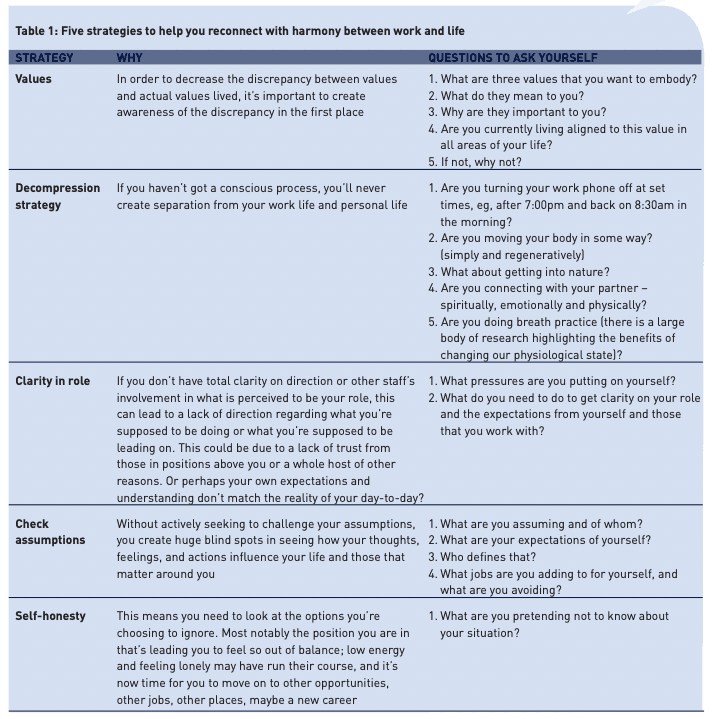
However, there are strategies that you can take control of today to begin to create harmony within your life – see Table 1.
2. You are not your job – detaching yourself from the logo
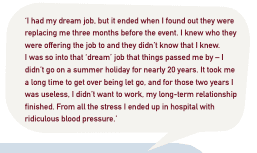
JF: This is one topic which is close to my heart because I have been that guy. In fact, I have been the guy who has no boundaries, no work-life balance, nor indeed any deeper understanding of self beyond the job. So, I know how it feels to be all in on the job and industry, to be content with that, and to even want it that way – until the job got pulled from beneath my feet.
I was completely obsessed with my job, and when I was asked to re-apply for my own job and did not get it, it hit me like a steam train. I was completely lost, a zombie for a long time, and I was totally gutted about the situation. I didn’t know what else I could do with my life, what I was going to do: I felt unwanted, my self-worth was in the gutter – I was like a total fraud who’d been found out.
No-one should have to put themselves through that. There is a really high chance that you’ll lose your job or be moved on at least once in your career, but there is absolutely no need to go through the mental torment that comes with it because you have attached your whole self to that role.
RH: This is an insidious issue that affected me as much as I hear it affected other practitioners in high-performance sport, which is highlighted in a revealing quote from a discussion I had with a leading sport psychologist:
For me, my identity of working in Olympic sports kept me locked in a profession that had become a trap. I felt shielded by the
persona that people put on me when they heard what I did for a living. This led me to maintain a role in professional sport to protect this image, despite being deeply unfulfilled and unhappy. People knew what I did for a career, but they didn’t know who I was.
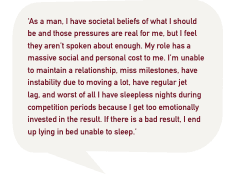
I’ve discovered that this problem is more widespread than I initially thought. Here is an example of a performance coach struggling with identity:
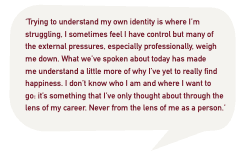
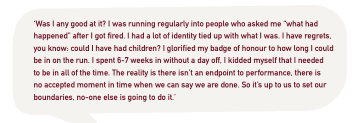
Many performance support staff feel so tied up in their identity of working in high- performance sports that it seems impossible to think of another way.
Here is another example from a leading strength and conditioning coach:
3. Protecting your boundaries
JF: I want to take a different slant on this, because I appreciate that it can be really tough to say no to a boss/line manager as an S&C coach, especially in the earlier years of your career where there is a line of coaches waiting to replace you.
So, my angle is around protecting you from you, creating boundaries for yourself with your practice and life – in order to ensure that you don’t over-deliver, that you actually switch off and regenerate effectively outside of work.
‘People knew what I did for a career, but they didn’t know who I was’
S&C coaches are first class at creating work for themselves! Step back and look at what truly moves the needle and focus on that. Try to use your commute to switch off: it isn’t a flick switch, it’s a dimmer switch – we aren’t robots! Be intentional about doing something you like. Top tip: listening to S&C/high performance related podcasts is not switching off!
The final point I want to make is about recharging, that relates to boxing off the basics of being non-contactable, doing something you enjoy, connecting, presence and removal of work when you are not on the clock.
Think of it this way: the already low salaries in this field are simply being diluted by every hour over your contracted hours that you work. Do the maths: are you doing a 60- hour week as opposed to your contracted 40 hours?
RH: To me, protecting boundaries requires you to get clear on understanding what’s important to you and why. When you understand that, protecting them becomes an easy process. Yet many practitioners I have spoken to struggle because they have simply not defined their personal boundaries as yet.
A lead technical coach in elite rugby league told me:
The majority of practitioners I have spoken to feel they need to say yes to more responsibility, more athletes to train, more data to analyse, more meetings to contribute to – whatever it is that makes them feel like they are being a successful member of the performance support team.
When we dig deeper into understanding why, these are the standout reasons I hear regularly:
1. Many people don’t know how to say no
2. They express a fear of reprisal if they do because they perceive saying no as solely negative
3. Many are unclear about their personal and professional drivers (values etc)
4. Even if they are aware of them, the work environment requires them to live and work out of alignment with them
5. The fear is that if all goes wrong, then there could be high consequences of saying what they think, such as losing their job – particularly if your employer is providing a visa that allows you to stay in the country.
A boundary is simply an invisible line you draw around yourself to identify what is acceptable and what is unacceptable. It doesn’t have to be fixed – in fact, boundaries are often fluid and ever-changing, depending on your goals, relationships and mental states.
What situations should you say no to?
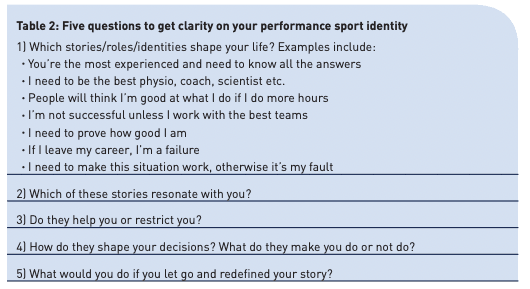
This fluctuates each and every day, yet principles stay the same. Your beliefs (values, needs and purpose) and roles define your principles.
Important questions to ask are:
1.Will these boundaries be sustainable without sacrificing the quality of your daily engagement with your family?
2. Will they allow you to maintain your self- care/well-being practices to keep up your health?
These are very common examples of boundary focus that I hear about in my work. Make this specific to you with regards to what your boundaries are aimed at right now. The most important part is to get clear on why you are saying ‘no’ to something, because a ‘no’ means you’re saying yes to something important to you.
4. Beyond the coach, a practitioner needs analysis
JF: I have been exploring this idea that the more time and attention you place on your life outside of work, the more abundance, growth and progression you will have in work. This reframe seems to really resonate and be impactful for people whose work-life harmony is quite out of whack at the moment. By placing more attention on life out of work, energy rushes to those areas, having a knock-on impact on overall well- being, and the quality of regeneration which we bring into the workplace.
Importantly, this actually allows us to have more to give at work, as essentially we are being much more focused on our lives as a whole, rather than on our work, which is simply just a part of our life.
When I speak about this with my clients, we discuss what they like to spend their time doing which has nothing to do with work and how we can remove the barriers to those things. So, what fills your cup, and how can you fit more of that into your life?
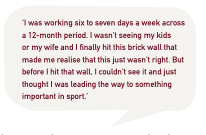
RH: This is a quote from a director of performance:
There are three important truths that we must address:
1. Sacrificing health and family for work is not an expression of loyalty – it’s a sign of having poor priorities
2. Dedication is not what you give up for your job – it’s what you give to your job
3. Accomplishments highlight your skills. Relationships reveal your values.
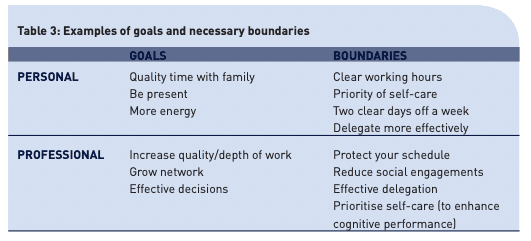
Getting clarity on this requires you to look beyond your role as a coach. Once you do this, you will be able to become the type of coach and career you want to be. I know this process as the ‘practitioner needs analysis’. You have most likely done many variations of this with the athletes and sports you’ve worked with over the years. But have you ever turned this process in on yourself?
Doing so allows you to identify what qualities are most important for you to emphasise in your role, career and life – to their fullest expression. It also provides an inner analysis that highlights the components of your life, giving you clarity on what is blocking you, how it’s blocking you and what you need to do to release those blocks.
This helps you to tailor your goals and actions away from potential burnout, divorce or illness, and turn instead towards a life where you thrive both as a practitioner and in your home life.
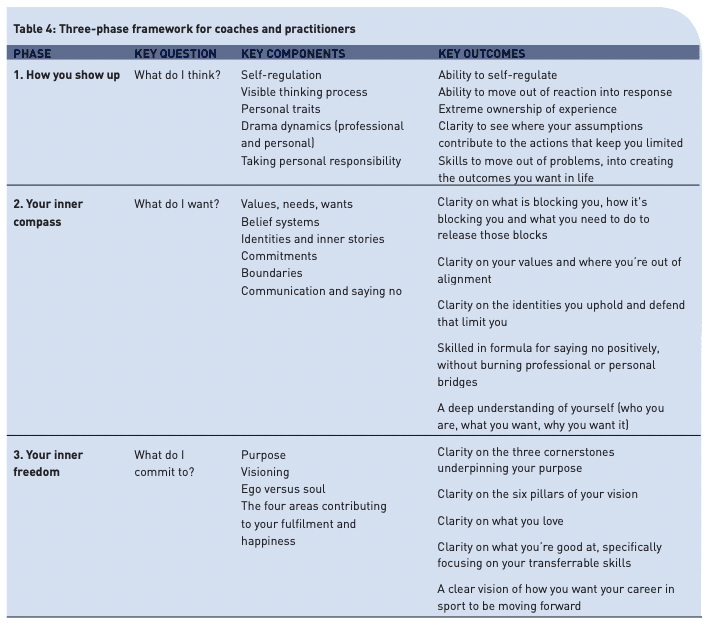
To help you with beginning this process, Table 4 describes the three-phase framework I use with the coaches and practitioners.

Richard was a performance coach for 16 years, including supporting teams preparing for two Summer Olympic Games – London 2012 and Rio 2016 – and the 2018 Winter Olympics in Pyeongchang. In 2015 Richard gave end-of-life care to his mother; in 2017 he had surgery due to a serious autoimmune health condition. These two experiences changed his life, allowing him to see what was truly important, and inspiring him to create Men Behind Sport, to provide the support he didn’t have as a practitioner. His work supports practitioners and coaches to look beyond just their role to unlock the qualities most important for them in their roles, careers and lives.

Josh is a performance coach with 15 years of experience working in elite environments. Josh has worked in Olympic sport, pro sport, Special Forces and F2/F3 motorsport. From burn-out to Olympic medals, bullying to military medals of recognition, redundancies to broken relationships, Josh has experienced it. His business, Career Blueprint, is driven to push for better awareness, support and prioritisation of coach well-being.