OVERVIEW
We are in the era of the scientific coach and there is logic behind this and there are benefits to be gained. The ability to make effective decisions lies at the heart of effective strength and conditioning and science is a wonderful tool to help us make these decisions. As strength and conditoning has evolved, its scientific basis has blossomed. Whereas once we often had to work with anecdotes, with hunches and with gut feelings, today we can work with data: real evidence about what works and what doesn’t, with real insight into the processes underpinning these results. Without doubt this approach has greatly informed and enhanced many aspects of our practice. Yet even in these enlightened times we can still be haunted by poor decisions, decisions that on the surface seemed the right call yet proved to be a disaster: how can this possibly be? Maybe we just aren’t as clever as we like to think, or perhaps some problems simply can’t be answered solely from the single perspectives of science.8 Many of our challenges deal with complexity and will always require an element of judgement, yet this key skill seems to have been sidelined in so many discussions.7,8 If judgment is important, we need to ensure that we are equipped to make effective judgement calls and this requires the ability to approach issues with open minds, view challenges from differing perspectives, and – vitally – to be able to think.
Why do we need to be able to think?
Although the picture often painted of our discipline is one of logical, evidence-led and rational frameworks, the reality is that so much of what we do does not fit into this neat framework.[8] Some decisions we have to make lend themselves to this logical, data- led approach, but others don’t.8 Logic is a wonderful tool for consistency and to answer certain types of questions, but it does have its drawbacks. There is a danger that our thinking can become purely algorithmic in nature: ie, if we see X, we’ll do Y. Medicine has consistently shown that such thinking can have benefits, but also serious side effects that may not become evident until a later date and that the best decisions are often those that balance logic with the lessons of experience and intuition.[9]
Given that effective thinking is built upon a latticework of models, we clearly need additional frameworks around which to think and make effective decisions, especially ones that are more suited to deal with complexity and situations where subjective judgements will always come into play. Therefore, although scientific frameworks will always be a key component of our thinking systems, we should ensure they don’t become hegemonic. Consequently, if our goal is to think more clearly and comprehensively, we should always be looking at other disciplines and incorporate useful tools from these into our thinking lattices. Indeed, it is highly unlikely that the wisdom required to master any profession will ever lie in a single discipline.
So, how can we learn to think more effectively, to examine challenges from multiple perspectives and help us make effective decisions against a backdrop of complexity? Well interestingly, there is a discipline that is specifically involved with how we think, how we live and the quest for a better life – namely, philosophy. Could it be that framing ourselves as a ‘philosopher coach’ rather than a purely ‘scientific coach’ will give us a better chance of success?
How on earth can philosophy help me? I’m a strength and conditoning coach!
In the words of the Roman poet Publius Terentius: ‘Nothing has yet been said that’s not been said before’.[11] In this rapidly evolving world, there will always be new information emerging and it is important that we stay abreast of this, but equally there remains a considerable amount of wisdom in the words of some of the most enlightened people from our past – many of whom can be labelled philosophers. Unfortunately, today, philosophy has an image of ivory tower academics, living in a world totally removed from reality and pontificating on problems that hold little if any interest to the average person.[3] In many instances, this image might well be true, and consequently philosophy is often overlooked as a source of knowledge and wisdom.
Yet, at its heart, philosophy is about understanding the world around us and guiding us to better decisions and better actions: it is this approach that potentially holds valuable insights for the S&C coach. Essentially, philosophy can help us to look at how we approach problems, not necessarily to offer solutions, but importantly to formulate the right questions and essentially finding a path for ourselves – as Seneca says, ‘that which is true is mine’.[12] This can be an important message – whereas a scientific mindset is often concerned with finding the right universal answer, using fixed methodologies, a philosophical mindset is often more concerned with finding a pathway for ourselves, one which considers context as being integral to any decision. In this way, it encourages us to look at challenges and problems from multiple perspective and not solely from the single perspective of science, enabling us to consider a wider range of options and to think through the range of likely consequences of any decision. Philosopher coaches will always employ science as part of their judgement-making process, but they must reject scientism – the belief that the only legitimate forms of understanding are scientific ones and anything which is not amenable to scientific methods of inquiry is baseless or meaningless.[1]
In its early incarnations in ancient Greece, philosophy was often associated with ‘Eudaemonia’ – how to live a good life. This search typically incorporated three areas of practice: thinking well, metaphysics (the theory of how the world works) and ethics (how to live), with all three contributing to what was termed the eudaemonic life. If we apply these three to S&C coaching, although the terms may not be necessarily ideal, we will find there is a parallel: our thinking relates to how we think about what we do and how we live; our metaphysics relates to how our world works in relation to S&C delivery and achieving effective results; and our ethics refers to how we deliver our coaching and live our life. The philosopher coach balances all three aspects, developing the ability to think clearly, gaining a deeper understanding of the metaphysics affecting the entire S&C process, and ensuring that we live a fulfilling life from both a professional and personal perspective. Ultimately, we get better by developing good habits – an idea associated with Aristotle but also Confucius, and associated with other traditions;[3] our habits must lie in all of the three realms.
Let’s lose the science-art dichotomy
An idea that has become embedded in many disciplines is the idea that science and art are separate entities, with differing goals and entailing differing thought processes and toolkits. Interestingly, one of the first things philosophers learn is that there is rarely a sharp dichotomy in any but the more trivial matters,[12] and it could be that this separation is actually an obstacle to effective thinking.
Language is one of our greatest tools for understanding, but it can also be a barrier to progress if it fails to capture the real essence of what we are looking at. Often, in strength and conditioning, we consider aspects such as programme design to be scientific, whereas much of the delivery will be considered as an art. Mention the concept of the art of coaching, and terms like soft skills, communication and the quality of relationships come to the fore – ie, right hemisphere-dominant processes, intuitive, built on insight and experience. Yet when we talk about the science of conditioning, our thoughts will turn to left-hemisphere dominant processes – ie, logical and rational, using hard facts with little room for subjectivity. However, if you delve a little deeper, these general notions seem far clear cut. Neuroscience has long known that the difference between the left- and right-sided brain is far less pronounced than many believe;[9] many activities rely on both logical thought structures and more intuitive and creative thoughts. Indeed, the areas often included in the art of coaching have a surprising amount of science underpinning them, such as communication strategies, behavioural approaches etc.
In a similar manner, even experimental science is not always the rationally objective realm that we may consider it, as it often requires judgement calls, what measures to take, how to structure a study, etc. Indeed, and rather ironically, despite the image of science being a hard-logical discipline, many of the leaps forward in science in fact resulted from creative ideas and the ability to see things from different perspectives. Galileo, Darwin, Einstein, and Curie amongst others were all scientists who thought outside the prevailing paradigms of their day. Maybe it is better to lose this science/art dichotomy and accept that effective practice must be a blend: insights that improve our practice are as likely to come from arts-based disciplines, as they are from those associated with science. Philosophers span this supposed divide, focusing crucially on enhancing action and at ease with drawing information from multiple sources, regardless of where they lie on this spectrum. In a similar vein, a philosopher coach must be comfortable drawing inferences and guidance from a wide variety of sources in the search for the best path.
Towards practical philosophy
Nowadays, philosophers are often caricatured as aloof, forever engaged in navel-gazing of no interest to the rest of us – or worse, peddling either nonsense or trivialities disguised by incomprehensible language.[12] However, the original incarnation of philosophy was quite different: the overriding theme was a matter of a little theory and a lot of practice,[12] with the key determinant being whether the philosophising led to useful actions. For example, the key goal of students at Plato’s Academy was to determine how men should live; it was not overly concerned with the intellectual processes involved in determining this.[4] The search for a pathway was uppermost in their processes and theory for theory’s sake was frowned upon, regardless of how clever that theory was – ultimately, if an idea was not considered as practically useful, it was not considered as useful at all.[12] This grounding in practice did not only influence the output of philosophy, but also the lives of many of the early philosophers. Many of the most famous names in philosophy, such as Socrates, Aristotle and Descartes, were practitioners – more generalists than specialist – exploring a wide range of topic areas that affected life but which we would now consider as belonging to different disciplines. They were the early polymaths, well versed in a range of disciplines, where research and practice happened side by side.[4]
Although the academic study of philosophy, as with many disciplines including strength and conditioning, has brought many benefits, these have not come without a cost. One of these benefits has been the rise of specialisation, allowing a far greater depth of study of the parts, but often at the expense of our understanding of the whole. Today, the work of academic philosophy increasingly takes place at the level of fine detail;[1] the goal has become publishing papers and this guides the modes and areas of study, even if the results have little practical value. In many disciplines – and I would argue that S&C is one of them – there are many questions that matter that do not fall into this level of fine detail or often even within any one intellectual discipline. Wherever specialisation results in a division of the knowledge needed for practice it can be dangerous. To focus too closely on a single discipline is to leave us open to blind spots, and simply removing these blind spots can significantly enhance our practice. Using the words often atttributed to Thomas McCrae, professor of Medicine at Jefferson Medical College, ‘more is missed by not looking than not knowing’.
We must become comfortable with uncertainty
Humans crave certainty and science is a great ally in this quest for answers. The scientific coach will often be looking for the single correct solution, one with published evidence to support it that can be applied across multiple scenarios. Unfortunately, the world of complexity seldom offers this luxury and certainty rarely, if ever, exists. A philosophical approach can help tame this ‘incertophobia’, an excessive fear of uncertainty.[3] The philosopher coach will be comfortable with the knowledge that a single perfect solution is impossible; they will consequently be open to weighing up various options. Crucially, they will be comfortable that decisions will most often require judgement calls and that judgment derives from context and cannot always be dictated by rules. Unlike science, where the search is for answers and laws, philosophy encourages the search for individual paths, guided by principles, but not limited by rules; encouraging issues to be considered from a range of perspectives using a range of models and tools, and always comfortable in the knowledge that an answer may be correct at one level and incorrect at another and that the ultimate decision will often be a trade-off between these contradictions. What is rational in one situation is not necessarily rational in another – decisions are ultimately context-specific.[1] The philosopher coach will consider that S&C guidelines should be usefully undoctrinaire and that there will always be a degree of uncertainty in any decision we make.
The quest for wisdom
One of the greatest lessons we can learn from philosophy is that wisdom represents the highest level of practice. Importantly, philosophy tells us that wisdom should never be considered purely as some higher form of intellectual thought. As Descartes says, in his 1637 Discourse on the Method: ‘It is not enough to possess a good mind; the most important thing is to apply it correctly’.[13] It is important to keep in mind that effective practice is not formulaic; it must rely on sound and skilful judgment, honed by years of practice – what the Greeks called phronēsis or practical wisdom[1] – and this should be the goal of the philosopher coach.
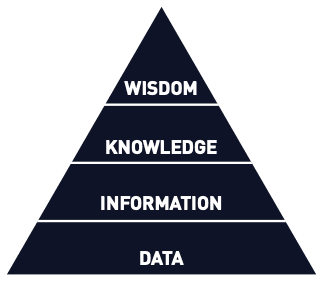
So how do we get to phronēsis? Well, the first thing we need to do is repeat Aristotle’s words that wisdom is ultimately practical and must not be based purely on higher levels of thinking. Wisdom can be thought of as lying at the top of a hierarchical pyramid (see Figure 1), where at the base level we have data, at the next level we have information, at the next level knowledge, and sitting on the top is wisdom. This concept of the hierarchical pyramid is important, moving as it does from data to informed action. Given that the goal of the philosopher coach is ultimately action, moving up this pyramid in the quest for wisdom is a path to master our craft, as the words of Francis Bacon neatly summise: ‘The great end of life is not knowledge but action’.
Today we are inundated with data, but a key question must be how much of this data is informing action. Simply having data is of no use if it doesn’t address the key questions we need answered, or if it cannot be processed into information that can help guide actions. This processing requires the development of effective models. At the data level, scientific and statistical tools are important, but as we move up the pyramid, we need further models to enable us to understand the meaning of the information we are generating. To rely on a single model, no matter how powerful, is hubris and inviting problems.[3] As a result, analysing data and generating information needs to entail more than simply adopting a statistical approach. A philosopher presented with data is trained to ask: Where does the data come from? What does it mean? What follows from it?[3]
Simply asking these types of questions of data helps makes sense of their meaning and also throws light on some of their potential drawbacks. Consequently, any information generated is more critically analysed. Moving further up the pyramid, knowledge organises information and is again based on models.10 Importantly, these models will have multiple uses: some will be used to explain, some will be used to predict, some to inform and some to guide actions – but importantly no one model will ever likely be sufficient for all scenarios.[10] As a result, knowledge needs to be based on a latticework of models and ideally drawn from a range of perspectives. Atop the hierarchy lies wisdom, the ability to identify and apply relevant knowledge.[10] Given that all the wisdom of the world will never be found in one academic department,[5] wisdom again requires many-model thinking drawn from multiple disciplines. It also importantly requires extensive experience, ensuring it entails the crucial feedback loops of trial and error. The wise philosopher coach understands clearly that effective practice can never be a priori, and effective action should never be simply based on logic – no matter how sound it looks on paper. Any inferences drawn and actions taken should reflect previous experiences enabling its practical soundness to be assessed – experience plays a crucial role in the path to wisdom. Coaches instinctively know this: ask any coach what most influences their decisions and few would say an academic paper – most would reflect on their own experience and of that shared with other coaches.
In today’s incarnation of strength and conditioning are we moving away from this experiential model to one where scientific evidence plays an overly dominant role. Philosophy has always espoused the value of experiential wisdom and advised against an overly scientific approach. Aristotle wrote in the fourth century BC that we should ‘pay no less attention to the unproved assertions and opinions of experienced and older people than to demonstrations of fact; because they have an insight from their experience which enables them to see correctly’.[2] Limiting our perspective risks foregoing the upper levels of the wisdom pyramid and becoming mired in the data. Crucially, we do not have to choose between objective, indisputable fact and mere opinion – outlooks, values and beliefs can be more or less reasonable, more or less objective.[1] As TS Eliot says: ‘Where is the wisdom we have lost in knowledge? Where is the knowledge we have lost in information?’ – to which the philosopher Scott Page suggests we add, ‘Where is the information we have lost in all this data?’[10]
Attention – a core value of philosophy
As outlined earlier, blind spots are a massive challenge to effective practice and blind spots result from a lack of attention. To paraphrase Oscar Wilde: ‘There may have been fogs for centuries in London, but no one saw them, and so we know nothing about them. They did not exist until Art had invented them’. His point here was that it was paintings by artists such as Whistler that brought the fogs into people’s attention. So how many ‘fogs’ are we simply not noticing due to them not being in our traditional sphere of attention? Paying close attention is a core component of the best philosophising, but crucially, the best philosophers do not assume they know the difference between the important and the trivial, the big and the small, as such assumptions blind them to insight.[2] Similarly, they are comfortable that no discipline will ever hold all the keys to what needs to be attended to. However, it is well established that our attention is easily captured by our prior beliefs, expectations and our training, and is affected by numerous biases;[2] all of which impact upon how we see the world. Simply thinking more philosophically enables us to explore a wider range of factors that have the potential to impact upon our practice.This in turn increases our awareness and brings into focus that that we may have previously overlooked but may have an important impact on our practice.
An interesting difference between the outlook of the philosopher coach and the scientific coach is the direction of attention. For the scientific coach, with the focus on evidence-based practice, the direction will predominantly be outward - to what we do. For the philosopher coach, although there will always be some focus on methods, a degree of attention will always be directed inwards. So much of our success or failure will be down to how we interact with our ecosystem, and consequently being aware of the direct and indirect effects of our actions is paramount. This will require a degree of introspection, and the need to practice the Socratic task, to know thyself, is paramount.[12] Importantly, this analysis must not simply revolve around knowledge, it must be all-encompassing; we must examine our beliefs, our values, our habits. As philosopher Massimo Pigliucci writes: ‘ignorance or, worse, self-deception, about our own abilities can be very dangerous’;[12] it will blind us to challenges we face and close the doors for improvement.
The rational sceptic – Socratic questioning
As highlighted earlier, in whatever field and even in our everyday life, one of our greatest challenges is dealing with the deluge of data and information we are subjected to, much of it of dubious quality. One of the ongoing challenges to philosophical thinking is to be sufficiently sceptical without tipping over into cynicism; as Aristotle asserts: ‘it is the mark of an educated mind to be able to entertain a thought without accepting it’.[4 ]
Clarifying our thinking is crucial in order to enable us to make effective decisions, and here again philosophy has a useful tool – that of Socratic questioning. This form of questioning helps us explore whether we are addressing the true crux of any problem, it encourages us to clarify what it is that we actually think in order to consider why we think in this way. It urges us to challenge any assumptions we make and encourages us to look for evidence to support or refute our ideas. It fosters consideration of alternative perspectives and approaches and urges us to examine the implications and/ or consequences of any action or inaction.[11] It even encourages us to examine whether or not the original question is appropriate and how appropriate are the conclusions we draw. The emphasis on the implications/ consequences of any actions encourages us to think more widely and emphasises the need for second-order thinking.[11] This involves evaluating the most likely effects and their most likely consequences, balancing higher-order thinking with practical judgment taken on a case-by-case basis and ultimately thinking for oneself – wisdom in action.
Summary
At some point in our careers and our personal lives all of us will have faced doubts and questioned ourselves. We will have encountered problems that defy logic, that confound us, and for which our training has simply not prepared us. Yet this should never be considered as unusual or even as a sign of weakness – Dante writes (in his Divine Comedy, Inferno Cante [1]): ‘Midway upon the journey of our life I found myself within a forest dark, for the straightforward pathway had been lost’. The philosopher coach may be better prepared for these times of doubt than the one whose thought processes are purely scientific. The scientific coach may be looking for the right answer, whereas a philosopher coach is more likely to focus on simply making a good rather than a ‘perfect’ decision, happy in the knowledge that although good decisions can never guarantee good outcomes, on average they will be more successful than poor decisions.[6] The philosopher realises that the path to greater clarity is going to be one of trial and error, where mistakes and missteps are inevitable.
Simply by consistently employing good decision processes and taking wise actions, we can stack the odds in our favour. Furthermore, the benefits of the good decisions will accumulate and over many years will make a significant difference in the quality of our practice and our lives.[6]
For the strength of the philosopher coach lies not in blindly following any pre- set path, but in combining the wisdom of philosophical traditions with the best that science can advise us – ultimately we find our own path to mastery.[12] As Seneca elegantly puts it: ‘Men who have made these discoveries before us are not our masters, but our guides. Truth lies open for all; it has not yet been monopolised and there is plenty of it left even for posterity to discover’.[12]

Ian is a prolific coach, author and educator who consults extensively with several international sports organisations. He is President of the NSCA, Editor of the UKSCA's journal, Professional Strength and Conditioning, and is also on the Editorial Board for the NSCA's Strength and Conditioning Journal, and the Journal of Australian Strength and Conditioning.