Congested fixture schedules in elite soccer can exacerbate fatigue, impair physical performance and increase injury risk. Because neuromuscular impairment and residual fatigue may persist for up to 72-hours after match play, coaches and performance staff often prioritise recovery in the days following. However, this emphasis may reduce opportunities to maintain lower-body resistance training exposure and, over time, may compromise broader strength qualities and tissue capacity. In response, brief lower-body resistance training sessions performed within 30-minutes of match completion have been used in selected elite environments as a practical means of addressing the recovery, performance and scheduling dilemmas. In this applied narrative review, the rationale for this approach is examined by outlining the fatigue recovery demands of match play, the challenge of maintaining consistent lower-body strength work during congested periods and consequently, presenting an applied framework, which has been introduced and progressively refined since the 2023/2024 season within an elite soccer team competing in the UEFA Champions League.
Maintaining lower-body resistance training exposure during congested fixture periods remains a persistent challenge in elite soccer. Congested schedules, typically defined as successive matches separated by fewer than 96 hours20, reduce the time available for physical preparation while concurrently increasing the importance of recovery, tactical preparation, travel and readiness for the subsequent fixture. It is not uncommon for elite soccer players to compete in more than 60 matches across a 45-week season,14 which in turn, helps to explain why fixture congestion can substantially reduce opportunities to maintain exposure to lower-body resistance training. The relevance here is that maintaining resistance training exposure across the season may help preserve physical qualities relevant to performance. Consistent with this, in-season strength maintenance training has been shown to support the retention of strength, sprint and jump performance in professional soccer players.22 Lower-body resistance training may also be relevant beyond performance maintenance, particularly in relation to injury risk reduction, preservation of tissue capacity and broader physical robustness during congested periods. Observational studies have indicated that injury rates may increase modestly during congested periods and later stages of the competitive season, although these patterns should be interpreted as contextual rather than attributable to any single isolated factor.20, 26 Together, these observations strengthen the applied rationale for preserving lower-body loading exposure across the competitive season.
Despite the aforementioned narrative, one of the key challenges is that these qualities need to be maintained while practical opportunities to train them are somewhat limited. One clear reason for this is the residual fatigue associated with match play. Soccer match play is characterised by high physical demands, including large running volumes (9–12 km), frequent high-intensity actions (~8–10% of total distance) and repeated accelerations, decelerations and changes of direction, all of which impose substantial eccentric loading demands on the lower limbs.2, 8, 20, 15 Given that eccentric muscle actions are associated with muscle damage more than concentric actions, these demands are likely to contribute to skeletal muscle damage and inflammatory responses.19 Furthermore, soccer competition also induces substantial neuromuscular and perceptual fatigue, soreness, and impairments in muscle function, with some markers of recovery remaining disturbed for up to 72 hours.2, 9, 16, 18, 23, 25, 27 As a result, the window of opportunity in which lower-body resistance training might otherwise be scheduled often overlaps with the period in which players may be least prepared to tolerate it. This creates a persistent programming dilemma – i.e., how to preserve lower-body strength exposure without imposing an unnecessary cost on recovery or readiness for the subsequent fixture, whilst maintaining strength qualities that are pertinent to both performance and athlete robustness. This issue is particularly relevant in the following example context. From September 2025 to February 2026, PSV Eindhoven averaged 5.6 matches across 22.6 eligible days per month, equivalent to one match every 4.0 days. Although international break periods were excluded from this analysis, those windows did not necessarily provide meaningful recovery or training opportunities because 54% of our squad also represented their respective national team. Consequently, the practical opportunity to schedule dedicated lower-body resistance training was even more restricted than the club fixture schedule alone suggests.
With this in mind, some practitioners have implemented brief lower-body resistance training sessions immediately (< 30 minutes) after selected matches,21 particularly when later opportunities are limited or absent.3 To be clear, this is not being presented as a physiologically optimal strategy; rather, it may represent a pragmatic means of preserving lower-body strength when fixture congestion removes more favourable alternatives. Because direct evidence remains limited, the aim of this narrative review is to determine whether there is sufficient indirect evidence, theoretical rationale and applied logic to justify immediate post-match lower-body resistance training as a strategy in elite soccer and to present an applied framework developed within a team competing in the UEFA Champions League, where fixture congestion is a routine practical challenge.
To the author’s knowledge, no study has directly examined the effects of immediate post-match lower-body resistance training in elite soccer players. As a result, the rationale for this strategy must be informed by adjacent work including post-match timing studies investigating the temporal changes in physical capacities during the recovery window, concurrent training research, conceptual discussions of post-match resistance training, broader fatigue recovery literature and practitioner reports. Among the closest studies to the present strategy, is the work of de Oliveira Goulart et al.,7 who examined the timing of lower-body resistance training after match play in female footballers. Although this study did not assess an immediate post-match intervention, it directly addressed whether the timing of lower-body loading within the post-match period influenced subsequent recovery. Their findings suggested that in professional female footballers, lower-body resistance training performed 48-hours post-match appeared less favorable for 72-hour recovery than training at 24-hours post-match, with a small negative effect on countermovement jump height (ES = -0.38), a large negative effect on 10m (ES = 1.63) and 20 m sprint times (ES = 2.13), and a moderate effect on muscle soreness (ES = 0.69). In contrast, the 24-hour condition showed trivial to moderate effects across these outcomes (CMJ height: ES = 0.08; 10m sprint: ES = 0.66; muscle soreness: ES = 0.25). Despite no statistically significant between-condition differences, this is likely a by-product of the study being under-powered – a persistent challenge for research in elite level sport. This is relevant because it challenges the assumption that delaying lower-body loading automatically provides a more favourable window of opportunity. A similar principle was evident in the work of Cross et al.5 who showed that simulated match play altered subsequent neuromuscular function and fatigue with reduced maximal voluntary force by 14.6%, quadriceps contractile function by 31.5% and voluntary activation by 8.9%, with the subsequent fatigue profile differing according to whether concurrent training was prescribed 48- or 72-hours after match play. Taken together, and although based on only two empirical studies, these findings indicate that the timing of post-match loading can meaningfully influence recovery status and training tolerance. Broader recovery literature provides further context for these findings, supporting the view that both central and peripheral components of neuromuscular fatigue may remain altered beyond match play, with some impairments persisting for up to 72-hours.4, 18, 11 This is especially relevant in congested schedules at the elite level, when match-day (MD)+3 may itself be another match-day and players must be ready to perform with minimal residual fatigue. Together, these findings indicate that the practical window for scheduling lower-body resistance training may remain constrained even when loading is delayed.
It is also important to consider that different training interventions performed after match play may influence the recovery of physical and neuromuscular performance differently.28 Conceptual work from Sabag et al.24 concluded that upper body resistance training after match play was unlikely to accelerate recovery but could be considered potentially compatible when session volume and intensity were appropriately controlled. Although their review did not address lower-body loading directly, it provides an important principle for the present paper. The recovery cost of post-match resistance training is likely influenced by the muscle groups targeted, the exercises selected and the total session dose, rather than by timing alone. This is particularly relevant in soccer, where explosive match actions such as accelerating, decelerating, sprinting and changing direction impose substantial lower-body mechanical stress and can contribute to skeletal muscle fiber disruption.12
Practitioner reports also provide an additional applied layer for consideration. Published accounts from elite soccer environments describe brief post-match sessions built around familiar exercises.21 More recent examples from Premier League practice also describe the redistribution of gym load into shorter, more frequent exposures during congested schedules, including lifting sessions taking place on MD+1.17 Comparable approaches have also been described in other congested team sport environments, including professional basketball, where short microdosed strength exposures and post-game lifting are used to preserve loading opportunities across dense competition schedules.29 Although these reports do not establish efficacy in isolation, they do provide insight into how experienced practitioners are addressing the same logistical problem in elite settings and support the practical feasibility of the strategy. Overall, the current literature does not provide direct evidence, although relevant indirect support does exist.2, 5, 7, 21, 24
The rationale for immediate post-match lower-body resistance training is strongest when it is integrated within a broader seasonal strength plan. Pre-season provides the clearest opportunity to build lower-body strength, power, capacity and general robustness, before congested fixture periods begin. In-season work can then be used more realistically to maintain those qualities when later loading opportunities become limited. In practical terms, pre-season also allows coaches to establish the profiling, exercise menu and individual routines that underpin the post-match model. As a result, later post-match sessions are not improvised, but delivered as a continuation of an existing strength framework.
Before outlining the present decision-making model, it is useful to recognise how match-day turnaround length shapes the placement of specific training contents across a given microcycle. Figure 1 presents practitioner-derived programming preferences across different match turnarounds from a survey of 100 practitioners working in professional football clubs across Europe, the USA, South America, and Asia.3
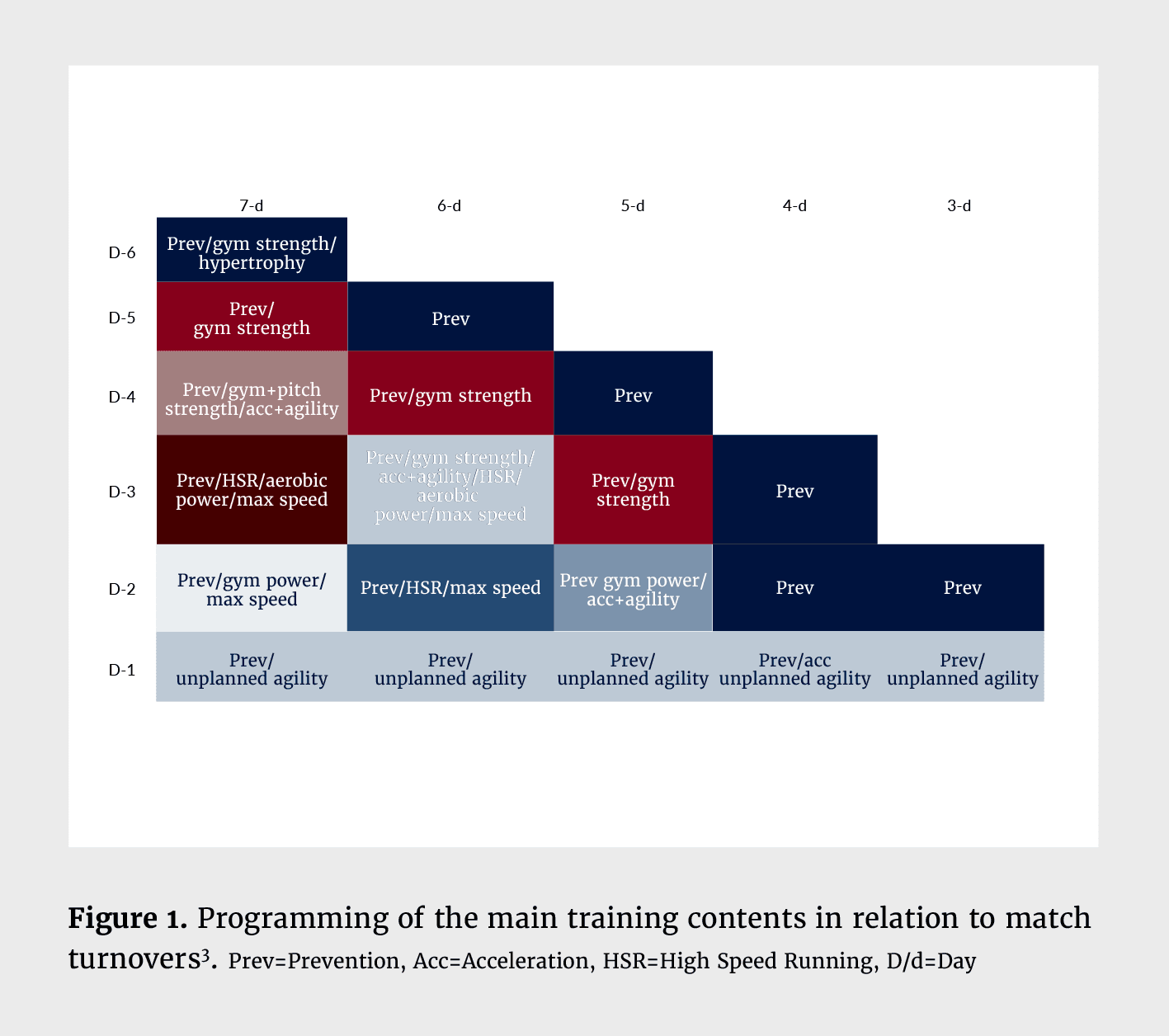
The Buchheit survey3 highlighted that as turnaround length decreases, opportunities for dedicated gym sessions also decline, with greater emphasis placed on recovery and preparedness for the upcoming fixture. In that survey, practitioner preferences for gym-based strength and power sessions were highest in longer turnarounds, peaking on MD+3/MD-4 with 73% (strength) and 45% (power) in 7-day microcycles and 39% (strength) and 31% (power) in 6-day microcycles. These values then declined to 21% (strength) on MD+2 and 14% (power) on MD+3 in 5-day turnarounds, 17% (strength) on MD+1 and 10% (power) on MD+2 in 4-day turnarounds and 6% (strength) and 6% (power) on MD+1 in 3-day turnarounds.3 While the Buchheit survey provides a broad practitioner overview of how training contents are organised across different turnaround lengths, Bower et al.1 conducted a more recent survey of 77 practitioners working across the four tiers of the English men’s professional league pyramid: i) Premier League, ii) Championship, iii) League One, and iv) League Two, offering a more recent and context-specific insight into how gym exposure is managed during congested domestic schedules. In the Bower survey,1 gym exposure in 3-day turnarounds was reported on MD+1/MD-2 by 20% of respondents and on MD+2/MD-1 by 23%, whereas in 4-day turnarounds, reported gym exposure was 19% on MD+1/MD-3, 68% on MD+2/MD-2, and 11% on MD-1. The differences between the 2021 Buchheit survey and the more recent 2026 Bower survey may reflect an evolution in practice, whereby practitioners have increasingly adopted a microdosing approach in an effort to maintain physical qualities while minimising disruption to recovery and match readiness during congested schedules.17, 21 However, Bower et al.1 did not clarify whether these gym sessions were strength or power oriented, or whether they were completed by players with reduced match exposure. Notably, neither survey makes specific reference to immediate post-match lifting, which further emphasises that this remains an under-explored, practitioner-led strategy rather than an established programming norm, whilst reinforcing the view that there is no single optimal or universally applied periodisation model in elite football. Given these scheduling constraints, an applied decision model (Figure 2) may help practitioners determine when immediate post-match lower-body resistance training may be both viable (and even appropriate). In the present context, this framework applied only to home matches, as away fixtures naturally presented the inter-disciplinary team with logistical and equipment constraints that limited the feasibility of the strategy being implemented.
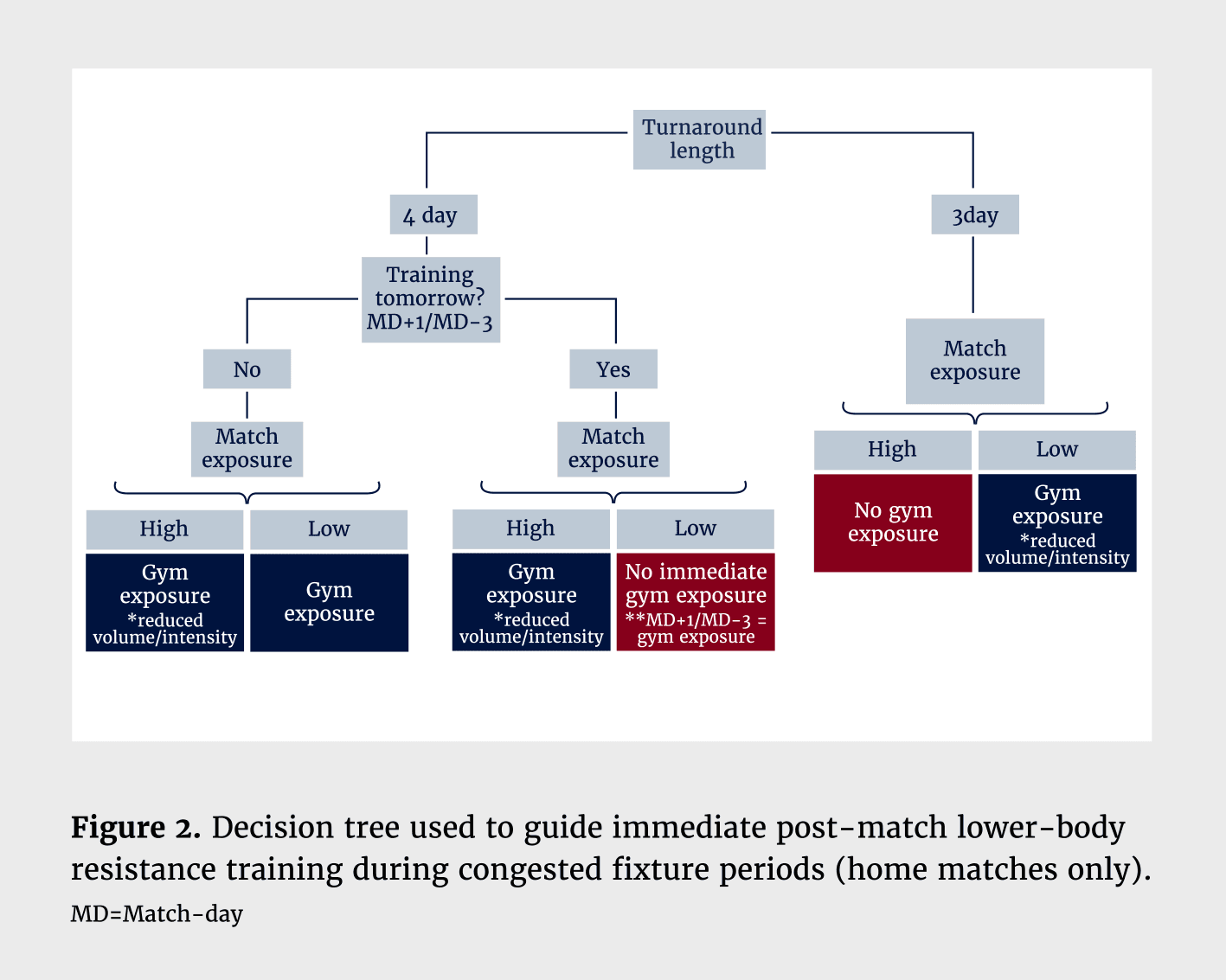
Within the present model, turnaround length is the primary decision point. For players with high match exposure in 3-day turnarounds, the priority is typically recovery and availability protection, with post-match cooling and compression often used to manage fatigue and support readiness for the subsequent fixture. In contrast, when players have completed less than 45-minutes, post-match lifting can be prioritised so the MD+1 can remain more recovery-focused and the squad can collectively follow a more consistent periodization structure before the next match, scheduled 48-hours later. This is important because congested weeks can reduce accumulated training load and create unequal loading across the squad.1, 10 However, selected 4-day turnarounds do provide a more workable context for players with high match exposure. The additional 24-hours can provide a more workable opportunity to re-introduce strength orientated loading, while still allowing recovery modalities to be applied in the days following to minimize interference and support tissue remodeling. This is consistent with recent applied work in elite football, which emphasises aligning recovery strategies to the dominant objective of the microcycle,26 and, with the broader reality that fixture congestion constrains training opportunities and requires redistribution of load across the microcycle.1, 6, 13
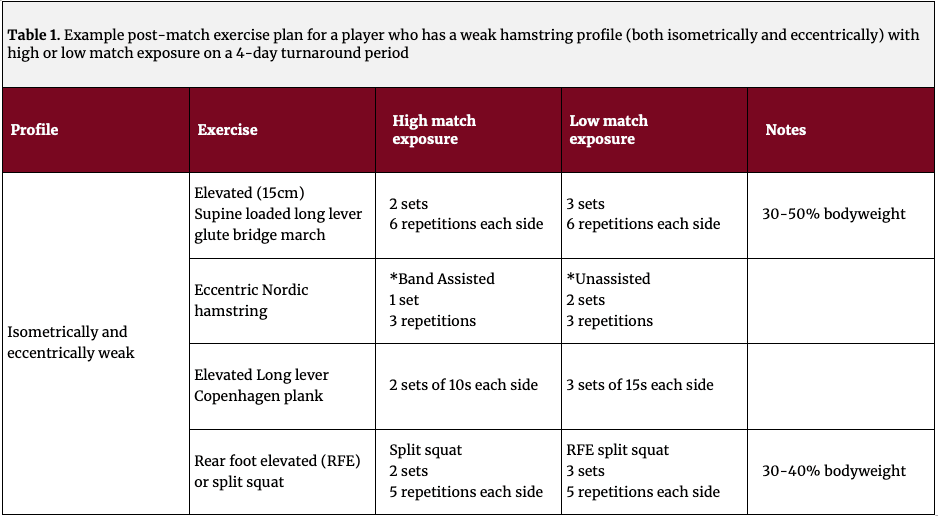
When a post-match session is implemented, exercise selection should remain simple and familiar. In practice, players are grouped together derived from physical profiling and benchmarking sessions, with exercise selection then adjusted according to deficits, injury history, asymmetries, tissue-specific priorities and current physical needs. For example, hamstring exercise choice may differ according to whether a player presents as relatively strong or weak in eccentric and isometric qualities alongside match exposure and the likely mechanical cost of the exercise. This allows the post-match session to retain a consistent structure while still targeting individual deficits in a practical and time-efficient way. Table 1 presents an applied example of how this process may be translated into a brief post-match lower-body session. As a final point of consideration, it should be noted that there are also clear reasons to allow players to withdraw from a training session if needed. For example, emotional state, medical concerns or unusual match demands may all justify cancelling a session and this flexibility should be viewed as a strength of the model, whilst reflecting the realities of elite practice.
The principal potential benefit of immediate post-match lower-body resistance training exposure is that it preserves meaningful lower-body strength and targeted tissue loading, in weeks in which that exposure would otherwise be lost. This may further justify efforts to preserve lower-body strength exposure during congested periods, where match play injury risk may be increased.8 In this sense, the relevant comparison is often not between immediate lifting and an ideal later session, but between a small, controlled maintenance session or no meaningful lower-body resistance training session at all. The risks are equally clear too. Match play already creates substantial fatigue and the available timing studies suggest that tolerance to further loading is dependent on when and how that loading is applied. Immediate lower-body lifting may therefore increase skeletal muscle damage and soreness, while reducing readiness. This may negatively affect both recovery and subsequent performance. A further practical risk relates to compliance and culture. Even where the physiological rationale is defensible, if players do not understand the purpose or logic of the session and view it as an unnecessary burden, the practical value of the strategy may be reduced regardless of its theoretical merit.
In light of the narrative presented herein and the fact that many of the aforementioned suggestions are not fully backed by robust, empirical evidence, a number of suggestions have been put forward that researchers may wish to consider, but also for practitioners as well, who may wish to consider some ‘trial and error’ initiatives in their day-to-day practice with their teams and players.
Immediate post-match lower-body resistance training should not be presented as a universal strategy in elite soccer; however, in congested schedules where later training windows are limited, a post-match session may represent a pragmatic approach. Because direct evidence remains limited, so too does our understanding of the recovery kinetics, including the central and peripheral responses to immediate post-match lower-body resistance training and its broader implications across congested fixture periods. Future research should aim to clarify the dose-response relationship within realistic soccer microcycles, determine its cumulative value across congested phases of a season and establish whether responses differ according to player profile, match-day exposure and turnaround length. Within our environment at PSV Eindhoven, we view this post-match lifting strategy as a practical and contextually viable solution. It is not a one-size-fits-all approach and practitioners should instead be guided by turnaround length, match exposure, player need and logistical feasibility before determining whether they implement such a strategy.

Jermaine McCubbine is a UKSCA accredited, high-performance strength and conditioning coach currently working with PSV Eindhoven’s men’s first team. He holds a BSc in Sports Therapy and an MSc in Strength and Conditioning, and has previous experience at Brentford FC, Arsenal Women FC and within PSV’s youth set-up as the Lead Performance Coach. He specialises in performance enhancement, injury risk reduction and optimising rehabilitation outcomes.
https://scholar.google.com/citations?hl=en&user=PnHUiA0AAAAJ