This study evaluated the longitudinal stability of eccentric hamstring strength during the Nordic hamstring exercise (NHE) across a competitive season, comparing one-match and two-match weeks and examining differences between dominant and non-dominant limbs in professional footballers. Sixteen professional male players (age 24.6 ± 4.5 y; body mass 78.3 ± 16.3 kg, height: 1.80 ± 0.06 m) competing in the English Football League One, were monitored over 28-weeks of the competitive season. Eccentric peak force was assessed using a NordBord during standardised NHE protocols performed on match day minus four (MD-4) (2 sets × 2 repetitions) and MD+2 (2 sets × 1 repetition) during both single- and double-fixture weeks. Weekly external load variables including total distance, high-speed running distance and sprint distance were also recorded. A 28 × 2 × 2 repeated-measures factorial ANOVA examined the effects of week, fixture congestion and limb dominance on peak eccentric force. No significant interaction was observed between week and limb (p = 0.528), and fixture congestion did not influence peak force production (p = 0.300). However, dominant limbs produced significantly greater peak force than non-dominant limbs (p = 0.024, η²p = 0.295), with this asymmetry remaining consistent throughout the season. These findings indicate that eccentric hamstring strength remains stable across a competitive season, including during congested fixture periods, suggesting that appropriately prescribed NHE can be maintained to support the preservation of eccentric strength. Persistent inter-limb differences highlight the importance of ongoing monitoring and targeted interventions, as is deemed necessary by the support staff team.
Hamstring strain injuries (HSI) represent the most prevalent non-contact injury in professional football, accounting for approximately 24% of all injuries in men's elite competitions and imposing substantial competitive and economic burdens on clubs.5, 25 Given the established association between eccentric hamstring weakness and injury risk,30 the Nordic hamstring exercise (NHE) has emerged as an important exercise when considering the design of injury prevention programmes, with meta-analytical evidence suggesting that structured implementation of this exercise can reduce HSI incidence by up to 51%,12, 26, 36 However, these estimates should be interpreted with some degree of caution, as many of the underpinning studies exhibit notable methodological limitations, including: variability in compliance monitoring, inconsistent exposure reporting, heterogeneous injury definitions, and limited control for confounding training variables, which collectively, constrain the strength and generalisability of the reported effect estimate. However, practitioner adherence with NHE protocols remains problematic throughout the competitive season, primarily due to concerns regarding the exercise's high physiological demand and the delayed-onset muscle soreness (DOMS) that often characterizes eccentric loading.1, 23 The reluctance to implement NHE during fixture-congested periods reflects a broader tension between injury prevention and performance optimization in elite football.13 Contemporary match schedules increasingly demand that players compete with fewer than 72 hours between fixtures,2, 15 a scenario that has been shown to impair neuromuscular function, elevate muscle damage markers and compromise physical performance including sprint ability and torque production.9, 15 These observations have led to the widespread practice of reducing (or even eliminating) the NHE during congested periods to minimize additional fatigue accumulation and potential DOMS, despite the potential compromise to long-term injury resilience.4, 9, 33
Previous investigations of post-match neuromuscular function have predominantly employed isokinetic dynamometry,9 while highly reliable, present practical constraints regarding time efficiency, cost and ecological validity that preclude frequent longitudinal monitoring in professional settings.34 Furthermore, much of the existing literature has relied on simulated match protocols rather than authentic competitive exposure,13, 34 raising questions about the generalizability of findings to the complex psychophysiological demands of professional match play. Consequently, whether eccentric hamstring strength genuinely deteriorates during fixture-congested periods, or whether chronic exposure to NHE facilitates protective adaptations that preserve force-producing capacity, remains unresolved. Although some studies have effectively reported significant post-match changes in eccentric hamstring strength using the NHE,28, 29 these investigations were limited to pre- vs. post-match comparisons only and did not examine weekly or longitudinal fluctuations across competitive microcycles, which are central to understanding chronic neuromuscular responses. Furthermore, the age span in one cohort (14–19 years for the subgroup with the greatest decrement) encompasses wide maturational differences that may confound strength outcomes due to growth-related variability rather than match-induced fatigue per se.28 By monitoring professional adult players across an extended competitive period, the present approach provides a more stable and ecologically valid assessment of eccentric strength dynamics in response to fixtures and training load.
The presence of inter-limb asymmetries represents an additional consideration when monitoring eccentric hamstring strength in team-sport athletes.5, 7 Sport-specific demands, including preferred kicking limb dominance and unilaterally biased cutting manoeuvres, contribute to inter-limb imbalances that may also elevate injury risk.16, 21, 31 Further to this, it is unknown if fixture congestion impacts dominant and non-dominant limbs in the same way, which in turn, may potentially exacerbate these existing asymmetries. Therefore, the aim of the present study was to evaluate the longitudinal stability of eccentric peak force through NHE across a competitive season in professional footballers, specifically comparing one-match and two-match weeks, while also examining inter-limb differences. We hypothesized that peak vertical force would be significantly lower during two-match weeks compared to one-match weeks due to accumulated fatigue and that the dominant limbs would consistently exhibit higher force output regardless of fixture congestion.
A 28-week longitudinal repeated-measures design was used to examine weekly changes in eccentric hamstring strength in professional footballers and the influence of fixture congestion (single vs. double match weeks) and limb dominance. Peak force during the NHE was assessed weekly using a NordBord device with external load (total distance, high-speed running, sprint distance) monitored to contextualize neuromuscular responses to training and match demands.
Sixteen male professional footballers (age 24.6 ± 4.5 y, body mass 78.3 ± 16.3 kg, stature 1.80 ± 0.06 m) from a single English Football League One club volunteered to participate in this study. All players were contracted full-time and took part in one isometric session, one lower body session and one plyometric/ballistic jump session per week, during weeks with one game. During weeks with two games, players took part in two isometric sessions and one upper body session, on top of football training, with modifications only implemented for injury management or tactical requirements. Players were eligible for inclusion if they remained with the club throughout the entire 28-week monitoring period (excluding mid-season transfers) and were available for training and match play without long-term injury absence. Sample size was determined a priori using G*Power software (v3.1.9.7), with parameters set at effect size f = 0.25, α = 0.05 and power = 0.95, indicating a minimum requirement of 11 participants; the achieved sample provided actual power of 0.967. Ethical approval was granted by the University of Salford Ethics Committee, with written informed consent obtained from all participants and authorization provided by the club's Head of Performance in accordance with General Data Protection Regulation guidelines.
Eccentric hamstring strength was assessed using a NordBord (VALD Performance, Newstead, Australia) with integrated strain gauges sampling at 400 Hz. Players assumed a kneeling position with ankles secured superior to the lateral malleolus, trunk and hip maintained in neutral alignment and arms crossed over the chest. Following a standardized warm-up including two sub-maximal NHE attempts (via the assistance of a resistance band), participants performed maximal eccentric contractions, lowering their torso as slowly as possible while resisting knee extension. Strong verbal encouragement was provided to ensure maximal effort, with standardized instructions emphasizing hip stability and continuous hamstring engagement throughout the movement.36
The NHE protocol was integrated within the team's periodized microcycle. During single-fixture weeks, players completed two sets of two repetitions on match day minus 4 (MD-4) (approximately 96 hours pre-match), while during double-fixture weeks, two sets of a single repetition were performed on MD+2 (approximately 48 hours post-first match). This volume manipulation was designed to balance training stimulus with recovery requirements during congested periods. All testing was conducted post-field training within the club's gymnasium, with NHE performed as the initial exercise prior to supplementary lower-limb resistance or isometric training. On MD-4, players performed a structured warm-up emphasizing acceleration, deceleration and change of direction, followed by brief neural activation exercises incorporating 1v1 and 2v2 scenarios. This session was designed to maintain movement quality and neuromuscular readiness ahead of match play. On MD+2, players who participated in the previous match completed a lighter, individualized warm-up before either engaging in a low-intensity passing drill or moving directly indoors, depending on recovery status and coaching discretion. This approach aimed to balance recovery demands with minimal neuromuscular stimulus to preserve performance without exacerbating fatigue.
Weekly external load was quantified using 10-Hz global positioning system (GPS) devices (Catapult Vector S7, Melbourne, Australia) worn during all training sessions and competitive matches. Variables included total distance (TD), high-speed running distance (HSR; > 5.5 m·s-1), and sprint distance (SD; > 7.0 m·s-1). Weekly averages were calculated for players who completed all available training sessions within each microcycle, with match data also included in weekly totals. Only players who completed > 60 mins were taken into consideration for the weekly load estimate in order to obtain a true representation of the weekly demand. Non-starters where subjected to post-match or compensational training sessions according to the manager’s discretion. Furthermore, players on modified training loads or injury rehabilitation were excluded from weekly aggregate calculations. Across the monitoring period, players were exposed to mean weekly loads of 27,531.6 ± 6,104.1 m, 1,223.2 ± 308.8 m, and 235.1 ± 80.2 m for TD, HSR and SD, respectively.
Peak force (N) was extracted from the NordBord application and exported to Microsoft Excel (Redmond, WA, USA) for processing. The maximal value across all repetitions for each limb was retained for analysis, with inter-limb asymmetry calculated as: (Left-Right)/(Left+Right) *100. ICC data were calculated to assess within-week relative reliability, interpreted based on the lower bound 95% confidence interval, in line with suggestions from Koo and Li,22 where > 0.90 = excellent, 0.75-0.90 = good, > 0.50-0.749 = moderate, £ 0.50 = poor. Within a week absolute reliability was determined using the coefficient of variation (CV), with values < 10% deemed acceptable.20
A 28 (week) × 2 (fixture congestion: single vs. double) × 2 (limb: dominant vs. non-dominant) repeated-measures factorial ANOVA was conducted using JASP software (v0.18, University of Amsterdam), to examine main effects and interactions. Statistical significance was set at p < 0.05, with effect sizes reported as partial eta-squared (η²p) for omnibus tests with a scale of interpretation as follows: 0.01-0.059 = small, 0.06-0.139 = moderate and ≥ 0.14 = large.22
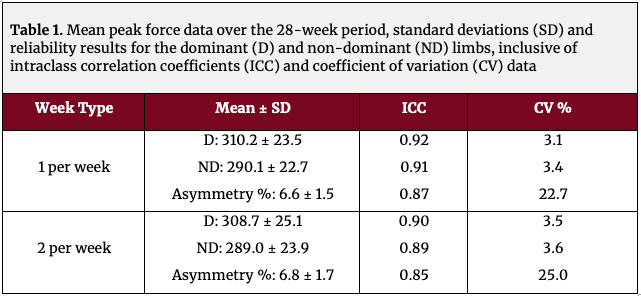
Participants completed 64 competitive matches across league and cup competitions during the 28-week monitoring period. Descriptive data for eccentric peak force across the season are presented in Figure 1, with weeks featuring double fixtures highlighted to illustrate the temporal distribution of congested periods. One game week reliability was excellent for both dominant and non-dominant limbs (ICC = 0.91–0.92; CV = 3.1–3.4%), with similar results for two games per week (ICC = 0.89–0.90; CV = 3.5–3.6%), supporting the consistency of the measurement protocol. In contrast, although inter-limb asymmetry data showed acceptable ICC data (ICC = 0.85–0.87), CV values were high, irrespective of how many games were played per week (asymmetry % = 22.7–25.0%). These data are summarised in Table 1.
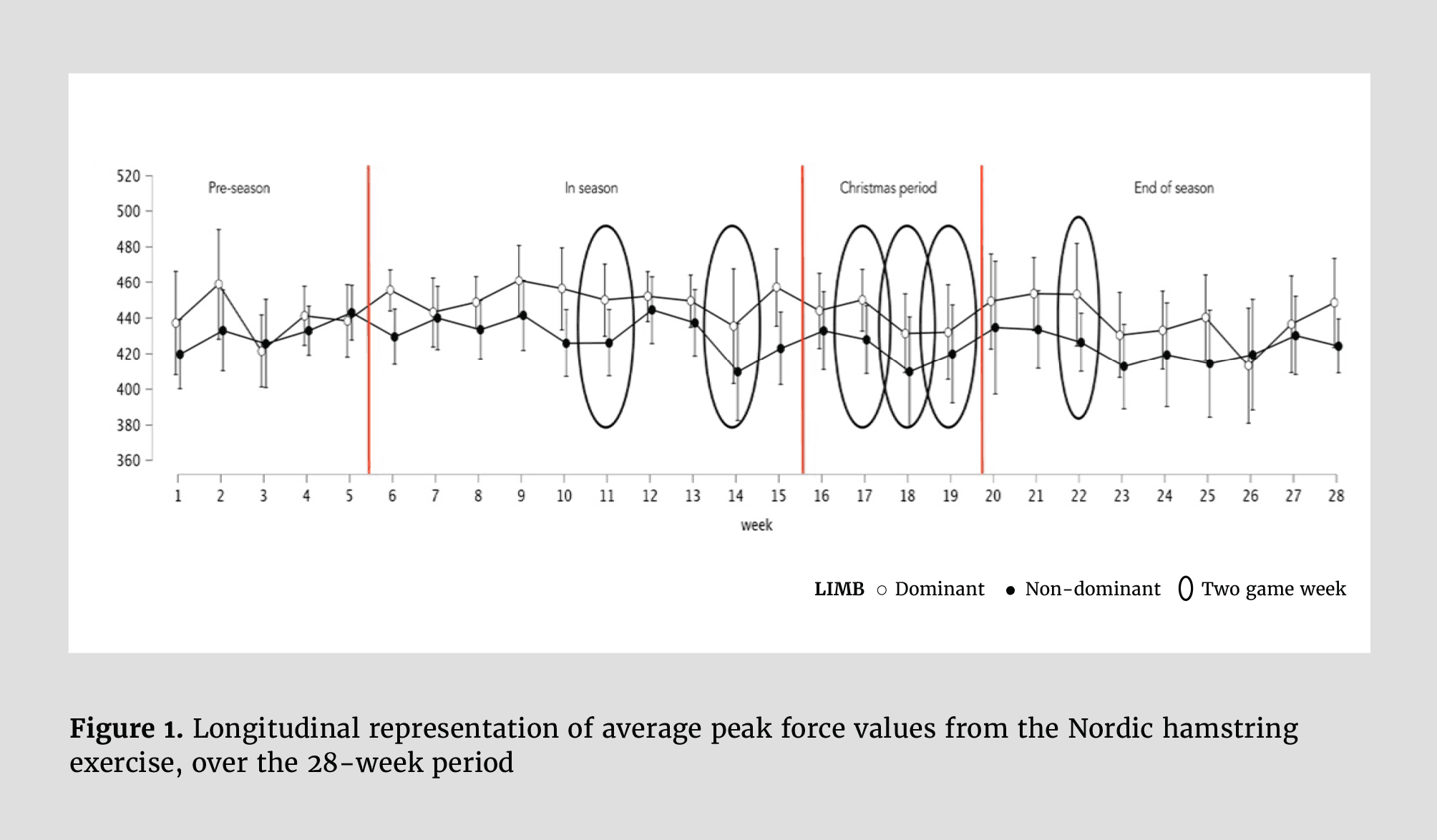
The repeated-measures ANOVA revealed no significant main effect of week on peak vertical force (F = 1.130, p = 0.300, η²p = 0.070), indicating stable force production across the monitoring duration. Similarly, no significant interaction was observed between week and limb (F = 0.958, p = 0.528, η²p = 0.060), suggesting that any fluctuations in force output occurred bilaterally rather than affecting individual limbs differentially. Contrary to our hypothesis, fixture congestion did not significantly influence eccentric peak force. The comparison between single-fixture (MD-4) and double-fixture (MD+2) assessments showed no significant differences (p = 0.300), with force values remaining stable regardless of whether players were completing one or two for matches per week. This finding persisted across the Christmas period, which featured the highest fixture density within the season. However, a significant main effect of limb was observed (F = 6.273, p = 0.024, η²p = 0.295), with dominant limbs producing consistently greater peak force than non-dominant limbs across all timepoints. This asymmetry remained stable throughout the season and was not moderated by fixture congestion (week × limb × fixture interaction: p = 0.528).
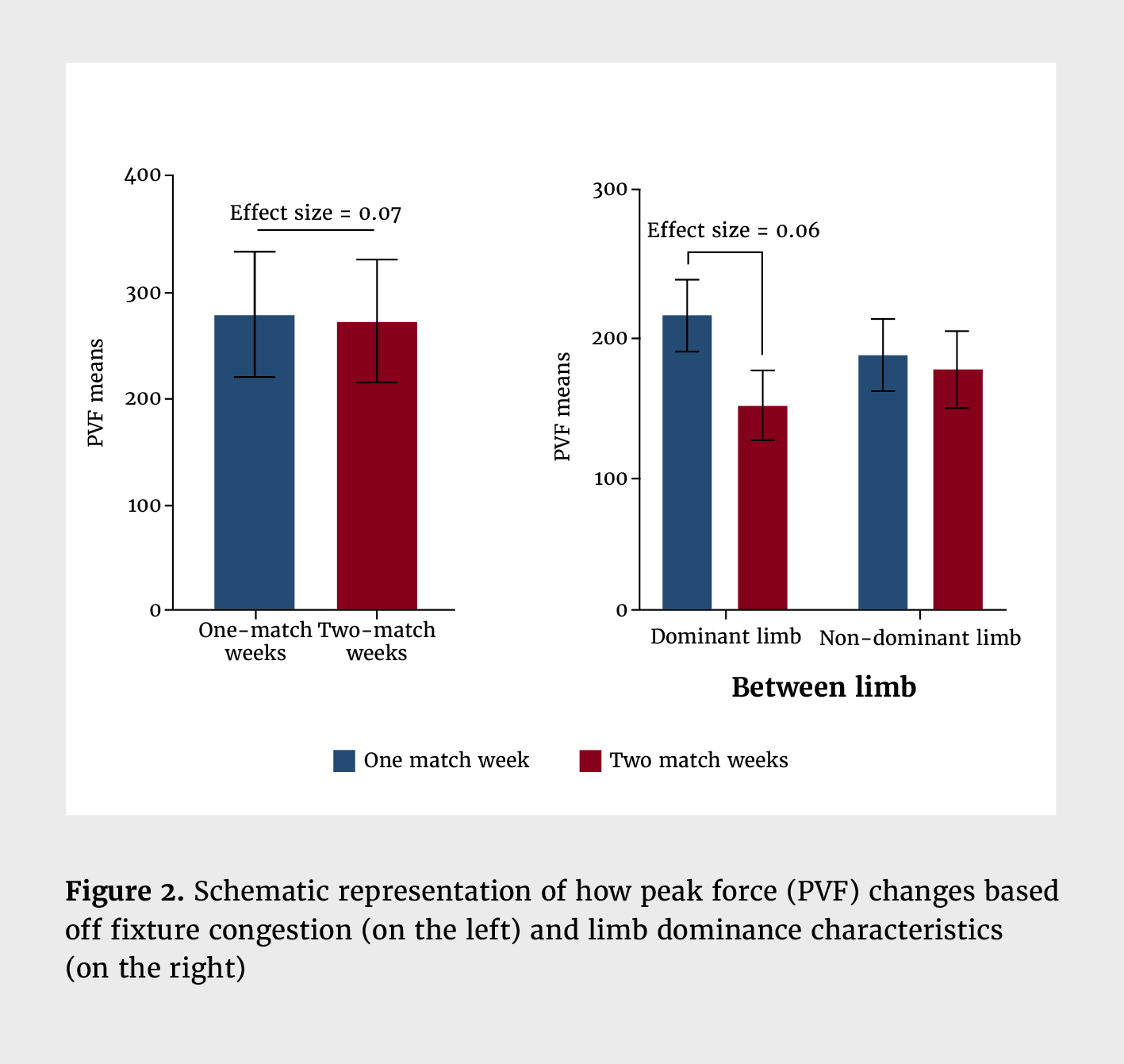
The findings of this study provide novel evidence that eccentric hamstring strength, as assessed during the NHE, remains stable throughout a competitive professional football season, including during periods of fixture congestion when recovery time between matches is substantially reduced. Contrary to our hypothesis, peak vertical force did not differ between one-match and two-match weeks, suggesting that appropriately prescribed NHE can be maintained without compromising force-producing capacity even when players compete twice weekly. Therefore, the proposed dose might only be effective to maintain levels of eccentric strength, with higher volumes needed to stimulate eccentric strength improvement. These findings have important implications for injury prevention practice, supporting the integration of NHE into congested schedules rather than withdrawal during high-demand periods.
The absence of force decrements during fixture congestion contrasts with previous researchers demonstrating impaired neuromuscular function, including reduced sprint performance and force and torque production, within 72 hours of competitive match play.9, 15, 20 Several factors may explain this discrepancy. Firstly, the chronic exposure to eccentric loading through consistent NHE implementation may have induced some sort of protective adaptations,11, 35 including enhanced muscle resilience and faster recovery kinetics, that mitigated acute fatigue effects.24, 25 Second, the NHE primarily assesses maximal eccentric force production rather than explosive or reactive strength qualities that may be more sensitive to fatigue-induced impairment.7 Third, the professional players in this study may possess superior recovery capacities compared to semi-professional, amateur or even youth cohorts examined in previous research, reflecting both selection effects and the comprehensive recovery modalities implemented within elite environments.3, 14
The stability of eccentric strength during congested periods addressed a significant barrier to eccentric exercises implementation in professional football.17, 27 Practitioners' reluctance to prescribe eccentric exercises such as NHE during demanding schedules has been attributed to concerns regarding DOMS and excessive fatigue accumulation that could compromise subsequent performance. 21, 36 However, the current findings demonstrate that the low volume of NHE applied (2 sets × 1 repetition on MD+2 vs. 2 sets × 2 repetitions on MD-4) does not result in detectable (p = 0.300, η²p = 0.070) force reductions, supporting the feasibility of maintenance dosing during congested periods.8 Given the established efficacy of eccentric training in reducing HSI risk,13, 18, 30 these results suggest that withdrawal of eccentric strength training during fixture congestion may be unnecessary and potentially counterproductive for long-term injury resilience.
The observation of significant inter-limb asymmetry, with dominant limbs producing approximately 6–8% greater peak force than non-dominant limbs, aligns with previous reports of bilateral strength imbalances in football populations across assessments 6, 8, 19, 32. The stability of this asymmetry across the season, regardless of fixture congestion, suggests that chronic football exposure does substantially alter the magnitude of limb dominance, at least in terms of maximal eccentric force production. While inter-limb asymmetries have been associated with elevated injury risk in some studies even though the different cohort, the clinical significance of the observed ~7% difference remains uncertain, particularly given that asymmetry did not predict force fluctuations during demanding periods.6, 7, 19
The present study is not without a few limitations. Firstly, the sample size was relatively small and drawn from a single professional team, which may limit the generalizability of the findings to other leagues, playing levels or female populations. Secondly, the monitoring period for two-match weeks was noticeably shorter than for single-match weeks (6 vs. 22, respectively), reducing statistical power for some comparisons and potentially underestimating subtle changes in eccentric strength or fatigue responses. Thirdly, the study focused exclusively on maximal eccentric force as the primary outcome, without direct assessment of other qualities such as muscle architecture, which may be more sensitive to fatigue or recovery status.10 Finally, while compliance with the prescribed NHE protocol was monitored, individual variations in technique or voluntary effort may have influenced peak force outcomes. Thus, future research incorporating larger, multi-club cohorts and additional neuromuscular metrics will be valuable to confirm and extend these findings.
The findings indicate that micro-dosed NHE volumes can be maintained throughout the season, including during congested fixture periods, without compromising eccentric force production. Low-volume exposure appears sufficient to maintain neuromuscular capacity, while modest adjustments to repetitions can accommodate recovery demands. Consistent inclusion of NHE as an eccentric exercise is therefore recommended, rather than withdrawal during demanding schedules. However, higher volumes may be needed if the goal shifts from maintenance to enhancing eccentric strength adaptations or restoring hamstring capacity post-injury. Routine bilateral monitoring remains valuable for detecting meaningful inter-limb asymmetries and guiding targeted interventions.

Andrea is an accredited UKSCA Strength & Conditioning Coach currently serving as Head of Strength & Conditioning for the Malta Football Association, where he leads the physical preparation for the senior national team and oversees the long-term athletic development programmes for the U15–U18 age groups.

Paolo Perna PhD is a sport rehabilitation specialist and accredited strength and conditioning coach currently serving as Lead Rehabilitation Physiotherapist at RC Strasbourg Alsace in France, where he oversees return-to-play processes and injury management within the professional squad.

Dr. Nicholas Ripley PhD, CSCS*D, RSCC, is a Lecturer in Sport Science and Strength and Conditioning at the University of Salford and serves as admissions tutor for the BSc (Hons) Sport Science programme.