Hello UKSCA membership! For those who do not know me, let me start my first editorial letter to you with a very brief personal history:
Before providing a brief outline of my vision for PSCJ, I really want to pay homage and express gratitude to Prof. Ian Jeffreys. Ian has carried the mantle of the journal on his shoulders for roughly 20 years. To say that I am now standing on the shoulders of a giant, is a literal understatement. In my opinion, having a journal is an important part of what any professional accrediting body can offer. I don’t say this because others do the same - I truly believe it is our collective responsibility to share information around good practice and science and this helps to drive the standards of our profession forwards. Remember, the UKSCA is a member-owned association which is why I say that we all have a collective responsibility. Ian is very much a practitioner at heart (and an excellent one at that) and his philosophy has been reflected in PSCJ, he has always viewed the journal as being one for the practitioner. So, once again, a sincere and heartfelt thank you to Ian for all his hard work in leading and coordinating all PSCJ-related activities for the past 20 years.
Moving forward, I’d like to share a little about my philosophy for PSCJ and the science of strength and conditioning in general. Historically, PSCJ has published narrative opinion pieces. I believe we should be striving to offer more diversified content. There are many different types of practitioner-focused scientific articles, such as:
Personally, I am striving to see PSCJ deliver on all these types of articles in order for us to deliver scientific content for everyone. Put simply, not everyone has an interest in undertaking empirical study research, but of course that doesn’t mean that they don’t like reading about it. Equally, whilst the methodological process of undertaking a systematic review or meta-analysis is extensive, it brings together all the science on a related topic and when done well, serves as one of the most impactful pieces of evidence for said topic. As outlined in issue 74, we are now actively encouraging the S&C community to consider submitting case studies too (and in multiple formats), with further details on article structure and submission options found here. I also believe there is a place for different columns within the journal. Whilst this may not be a guaranteed feature every issue, we will include columns relating to topics like exercise of the month, coaches corner, roundtable discussions, practitioner interviews and data visualisation spotlight. More information on these can be found on our new Guidelines for Authors section, on the PSCJ website. Thus, with such a planned diversified content moving forward, I would hope that PSCJ offers something for everyone.
There is one last point I’d like to share with the membership. Historically, PSCJ hasn’t always been a journal of choice for those looking to submit articles. Whilst this will undoubtedly take some time, this is something I am hoping to change and my start point is to try and get PSCJ ‘indexed’. As it stands, our journal is not indexed in any databases, which hinders our ability for work to be seen and cited. Naturally this represents an important part for any journal to grow professionally. There are a few options and routes for consideration, but we have chosen to try and get PSCJ indexed in Google Scholar. There are a few formatting and structural aspects required to make it eligible for journal indexing and truth be told, most of them have been completed over the past 2 years or so. We are now in the final stages of getting indexed in Google Scholar, which as previously mentioned, will help for our work to be both seen and cited. In addition to this, we are on a mission to drive increased content for the journal. As I hope you will have seen, we have appointed a new PSCJ Editorial Board team of 13 people who are hungry to drive PSCJ-related content forwards in 7 key strategic areas, details of which are in the table below.
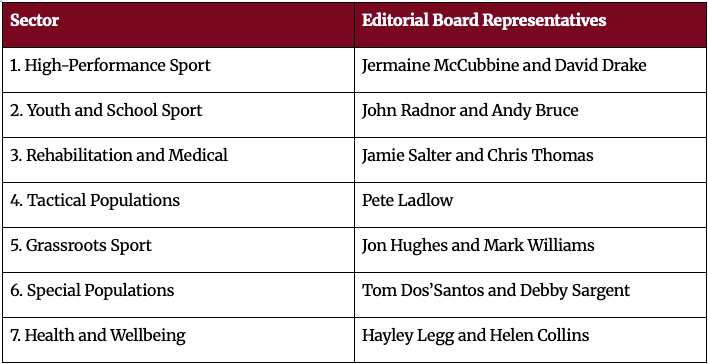
So, I would like to take this opportunity to thank the journal’s Editorial Board team for joining the UKSCA at a time when we are really striving for change in the content that we offer the S&C community. If anyone has any queries about contributing an article to the journal, then please don’t hesitate to reach out to me directly at C.Bishop@mdx.ac.uk.

Chris is the current Head of Department at the London Sport Institute, Middlesex University and has published over 300 peer-reviewed journal articles, edited / co-edited 3 textbooks and serves as the Editor-in-Chief of the UKSCA’s Professional Strength and Conditioning Journal, as well as a Senior Editor / Associate Editor for NSCA’s 2 flagship journals. From an industry perspective, Chris has a keen interest in all things training and testing for athlete and clinical populations. More recently however, most of his time is dedicated to the world of Performance Science in Golf, where he is the Principle Investigator for Sports Academy – the health, medicine and performance arm of the PGA of America, and also on the Science and Medical Advisory Board for The R&A, DP World Tour and Ladies European Tour.
Google Scholar: https://scholar.google.com/citations?user=jep0KcEAAAAJ&hl=en